

Message for reflection – Sr. Angelica AOJ
Continuation from the previous issue…
Gate No. 6 ENVY X LIFTING OTHERS
In order to get the sixth key, the guardian angel took the soldier to a house where a man lived with his family. He owned a big estate. It yielded a lot of money to him every year. But he was leading a simple life with minimum facilities. Once in 3 months he used to take his family to a particular place. The soldier was also taken there. He provided food for all the inmates of the institute. It was a leprosy rehabilitation centre. The soldier could witness him talking to the administrator of the institute and giving them financial aid needed for the next 3 months.
Like that the soldier came to know that he visited 4 institutes in a year and did the same. When the soldier enquired, he shared his life story. He was the eldest of the family and he worked day and night to bring up his siblings since they belonged to a low middle class family. When his brothers and sisters grew up, he helped them all to get settled in life. God blessed him more than all his siblings and rewarded him duly. But one day he came to realise that his brother, who was jealous of him, went to his father and made him sign in the property will which enabled him the owner of his elder brother’s property. He was left with nothing. But without worrying about it, he went on working. Carried no bitterness against his brother. He did not worry about his brother’s envious feelings! He did not allow anything to affect his happy life. Rather he wanted to help others with whatever the Lord had provided him with.
Mar 15:10 For he perceived that it was out of envy that the chief priests had delivered him up.
Rom 1:29 They were filled with all manner of unrighteousness, evil, covetousness, malice. They are full of envy, murder, strife, deceit, maliciousness. They are gossips,
1Co 13:4 Love is patient and kind; love does not envy or boast; it is not arrogant
Gal 5:21 envy, drunkenness, orgies, and things like these. I warn you, as I warned you before, that those who do such things will not inherit the kingdom of God.
Php 1:15 Some indeed preach Christ from envy and rivalry, but others from good will.
1Ti 6:4 he is puffed up with conceit and understands nothing. He has an unhealthy craving for controversy and for quarrels about words, which produce envy, dissension, slander, evil suspicions,
Tit 3:3 For we ourselves were once foolish, disobedient, led astray, slaves to various passions and pleasures, passing our days in malice and envy, hated by others and hating one another.
1Pe 2:1 So put away all malice and all deceit and hypocrisy and envy and all slander.
Gate No. 7. GLUTTONY X DISCIPLINE IN FOOD
In order to get the seventh gate key, the guardian angel asked the soldier to stay in a house to serve a man who was a patient. He was not to take fatty, oily food. Everything was plenty in his house. But due to overeating, he had invited all kinds of diseases in his body.
The soldier understood that the human body is the temple of God. It should be kept holy. No one should bring damage to the body by overeating, under eating, over work, stress, work pressure etc.
1Co 3:16-17 Do you not know that you are a temple of God, and that the Spirit of God dwells in you? If anyone defiles the temple of God, God shall destroy him. For the temple of God is holy, which you are.
Gen 24:33 And food was set before him to eat. But he said, I will not eat until I have told my errand. And he said, Speak on.
Gen 3:6 And when the woman saw that the tree was good for food, and that it was pleasing to the eyes, and a tree to be desired to make wise, she took of its fruit, and ate. She also gave to her husband with her, and he ate.
Psa 78:18 -19 And they tempted God in their heart by asking food for their lust. And they spoke against God; they said, Can God set a table in the wilderness?
Pro 23:1-3 When you sit down to eat with a ruler, look carefully at what is before you; and put a knife to your throat, if you are a man given to appetite. Do not desire his delicacies, for they are deceitful food.
Dan 1:8 But Daniel laid on his heart that he would not defile himself with the king's food, nor with the wine which he drank.
Rom 14:15 But if your brother is grieved with your food, you no longer walk according to love. Do not with your food destroy him for whom Christ died.
Continuation in the next issue…
Sr. Angelica AJ
FELLOWSHIP MEETING
The meeting was held on 28th February 2025 at Ammai Agaram, Kanmalai Kurichi. Sol. Thilagavathy(SMP), Mother, Sr. Angelica, Sr. Anita and 16 others attended the meeting. Sol. Thilagam said the opening prayer. The fellowship meeting was held at their house. Sol. Thilagavathy led everyone into worship. Sr. Angelica delivered a message from Matthew 5:13-14, “You are the salt of the earth. You are the light.” Then there was discussion and prayer. It was decided that the Fellowship meeting would be held next month at the home of Sol. Thilagavathi (SMP). Then the meeting ended happily with the closing prayer.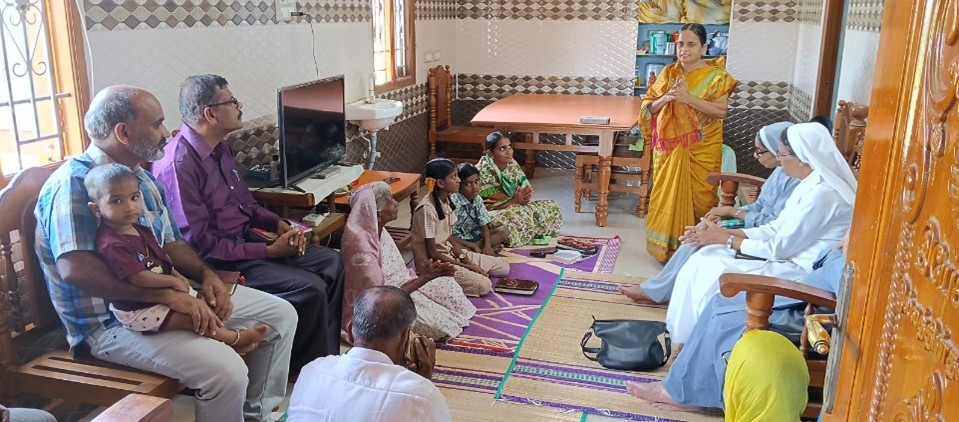

AUTHORITY
Let us do it for the Nation, Courts, Judges, Parliament, Media, Journalists, & all authorities of our Nation by the proclamation of our mouth.
1 Pe 2:9 But you are a chosen race, a royal priesthood, a holy nation, a people for his own possession, that you may proclaim the excellencies of him who called you out of darkness into his marvelous light.
Rev 5:10 and you have made them a kingdom and priests to our God, and they shall reign on the earth.”
Adam’s authority is restored to the Church. It is we who should exercise it.
We should take active role in & cooperate with the Government in our Nation. AOJ is given the strategy (Shadow System, SMP, SMLA STL etc.)
We should protect the planet earth from destruction and all kinds of damage.
Have I taken responsibility in the Shadow System? How faithful am I in it? Have I visited my Constituency? Do I take the survey report every month and present it in the Shadow Parli? Am I able to notice the progress in capturing authority over your Constituency? Were you able to bring situations under control by the usage of your tongue.
If not, this is the time to decide upon it. We are the rulers of our Nations. Not the political parties or any other systems. They should be spiritually controlled by the Troop Church. Nothing which is against the Word of God and the welfare of the people should pop up in the State or country.
TROOP CHURCH
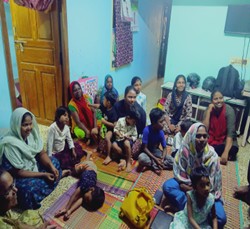
Praise the Lord! By the Lord’s grace and mercy, a New Troop Church named “Nambikai Bethesda” was started at VOC Nagar in Sol Lakshmi residence. Every Sunday 3 .30 pm to 6.00 pm nearly 20 members joined the troop. During message session the Lord healed a sister who had chronic cough with chest pain even after taking treatment in the hospital she had the issues more than 3 days. Suddenly, the Holy spirit asked her to prophecy for her own body and lungs. She did the same and received Calvary Healing from the Lord.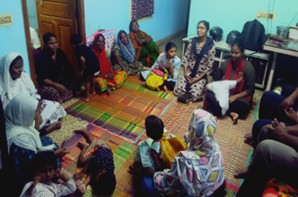
CIVIL TESTIMONY
Praise the Lord for Trichy being the cleanest in Tamil Nadu. Let’s prophesy that Trichy to be the cleanest city in the country India.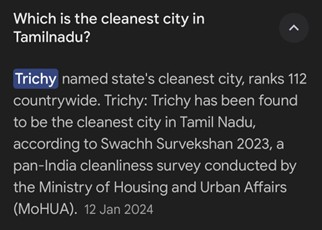
OTP TESTIMONY
My name is Punnia Topino. I have been living as a Christian for a few years, but I have no attachment to the name Christian. Not only do I always dream of snakes coming around me and biting me, but one day, a snake bit me. At that time, my aunt came and treated me. By the grace of God, I got well. I came here. However, I was not involved in the matter of getting baptised. I said ‘‘ I will not get baptised. I will attend to all the other things and study’’. I sat there saying this, but during the second week of the OTP training, during the worship school training, God made me realise my mistake then I cried. I cried and said, "Oh God, I apologise, forgive me and forgive my sins." I declared that I would be baptised. Then I got a great deliverance. I thanked God a million times. On that day, I was baptised. God's hand was with me. An accident happened. For a year, my brain was getting confused, I was not able to speak clearly, everything was like this, but as soon as I took baptism, God enlightened my mind. I got clarity. Thank you, God. The God who created me is guiding me. I dedicate myself completely to implementing everything I have learned in this training and to leading the troop church. I have dedicated myself as a missionary. Thank you so much. I want to go to my hometown and I hope I will get it. God, who gives back everything that was lost, will make this possible for me. I am ready to finish all these things and join the job very soon. May the name of God be glorified, Amen.
Morning Worship
Morning Worship is going on online (Zoom app) from 5:30 am to 7:00 am in Tamil Nadu and many other States in their own languages.
For details please contact
Sol. Shakespeare - 90037 71216, 62833 81962
Be Formed and Form (BFF) Info
Sapphire University
http://sapphireuniversity.in/
Those interested to know/join the university, for further clarifications and to know about our work may visit our website.
Information
Dear soldiers,
To keep information accessible we have made few web pages in the name of aojinfo.in, kindly store this address in your browser so you may access it any time. The addresses of the web pages are as follows
1) http://giftschool.online - Gift school schedule
2) aojinfo.in/beryl - Announcements of AOJ
3) aojinfo.in/wheel - Message
4) aojinfo.in/tc - Troop Church method, English
5) aojinfo.in/tcm - Troop Church eight week messages, English
6) aojinfo.in/troopchurch - Troop Church method, Tamil
7) aojinfo.in/tcmessage - Troop Church eight week message, Tamil
For Information
International Worship Coordinating team has been directed to collect any revelation/inspiration received during worship, (both personal/troop prayer atmosphere).We are expected to report these revelations every Sunday, scheduled meeting online.
We need to prayerfully move ahead asking the Lord for further directions to bring Divine Governance in our midst. Hence, we welcome you to participate in Kingdom building and restoration process. Kindly message the revelations with interpretations (as per the leading of Holy Spirit) on personal chat or Shield West group, by Saturday or before.
NOTE: Worship is the key to Prophecy.
CHILDREN BIBLE SCHOOL ANNOUNCEMENT
Jesus said, “let the little children come to Me, and do not forbid them; for of such is the kingdom of heaven.
Mt : 19:14
ADMISSIONS GOING ON FOR THE NEW ACADEMIC YEAR 2025 for both old and new students*.
Classes : 1std - 12th std
ONLINE CLASSES through ZOOM or Google meet.
MEDIUM: ENGLISH/ HINDI/ TAMIL/TELUGU / MALAYALAM/ KANNADAM
DAY : SUNDAYS BETWEEN 3PM - 5 PM
*FEE* FREE ADMISSION
CLICK HERE*👇AND FILL THE FORM TO ADMIT YOUR CHILDREN IN CBS
YOUR CHILD WILL NEVER BE THE SAME
CBS
AOJ
Kingdom Human Rejuvenation & Development Centre (KHRDC)
A Section 25(Not for Profit) company which focuses on Training and Skill Development in all the States of India.We provide training and equip them for workplace evangelism. We raise reliable, sincere and trustworthy people in the workplace like Joseph and Daniel who put God first in everything they do. Interested people can attend the Trainings. For details of Training, visit the Weblinks given above.
7 fold Agenda for the Global Churches/Church Leaders/Evangelists/Missionaries … (given on 27.10.2014)
To safeguard them from the evil one and solution for their Livelihood (Based On Early Christian Church Acts 2: 42-47)
- No mention about money or tithe offering (via online also) in the Churches
- No construction of Church buildings. Stop the Church building works even that are now going on.
- Moulding and training believers and releasing them from the Church after 6 months.
- Graduation of six months old believers
- Dividing the Church into small groups of 10.
- Pastors should look for jobs and get employed.
- No full time pastors for the church.
INTERNATIONAL WORSHIP CENTRE
No.70, (Old no 41) F1, First floor,
Bethel Enclave, Baba Foundations, (near SBI Branch)
Siruvallur High Road,
Perambur,
Chennai 600011.
International Worship Centre is a Centre where the Lord of hosts, the Lord God Almighty is worshipped in His majesty all the 24 hours. Per day 12 worship teams come to worship from different parts of the Nation. One slot consists of 2 hours. The opening of IWC also turns to be the trumpet sign to start the fatal war against Satan to win the Nation's for Christ! Do you want to join this praising Army?
Book your slots
Tel: +91 81489 13271
Praise God for the successful completion of 48,259 slots in International Worship Centre with a Non Stop Worship (24/7)
PROPHECY NEWS
THE ENIGMA OF CHINA’S DEBT CRISIS — EXPLAINED
China’s economic growth trend, which continues to stall, has become an important and attractive research topic for economists worldwide. Since Q3 of last year, China’s central government has begun to launch a series of fiscal and monetary policies in order to stimulate the economy to get back on track. Amongst all of the policies, the most striking is the “debt reduction plan” of up to 10 trillion yuan (1.36 trillion US dollars). The Chinese government has launched this unprecedented economic stimulus policy as a response to the current debt crisis, which has become the primary factor affecting many of China’s de facto predicaments, such as sluggish consumption, declining investment, shrinking exports, declining income and deflation, etc. If the current debt crisis cannot be properly resolved, it will gradually become the last straw that breaks the camel’s back for China’s macro-economy.
Explicit and implicit debt
Firstly, it is necessary to clarify that the debt mentioned in the article is not the same type as in the “debt trap”, which has essentially become a buzzword in the international geopolitical arena. The so-called “debt trap” mainly refers to China’s external sovereign financing to other less-developed countries (LDCs). In contrast, the debt referred to in this article is China’s domestic debt. More specifically, it mainly refers to the debt of Chinese local governments. At the same time, the Chinese government’s debt reduction plan is also aimed at local government debt rather than the debt undertaken by the central government.
To date, although China’s mainstream media is still doing its best to build a positive image of China’s economy and block all negative news, some clues about the true fundamentals can still be sniffed out from data released by the National Bureau of Statistics of China. For instance, according to the data, in 2016 there were merely six developed provinces that maintained fiscal surpluses; by the end of 2024, there were only two. The remaining 35 provinces were all in fiscal deficits. Despite being the leading economic province among all 37 provinces of China, Guangdong’s fiscal deficit reached 210 billion yuan (US$28.7 billion); similarly, Zhejiang — the second leading province — had a fiscal deficit was more than 90 billion yuan (US$12.3 billion), and Beijing — the third — had a deficit that exceeded 90 billion yuan. Likewise, Sichuan, located in the southwest and considered the leading economic province in Western China, had the largest fiscal deficit of all, with 410 billion yuan (US$56.1 billion) in 2024.
In addition to the drastic decline in government tax revenue, the main cause for the sharp increase in China’s local fiscal deficit is the depletion of the “land finance”—the rapid shrinkage of local land transactions. In 2024, China’s land transaction revenue was only equivalent to 50% of that in 2021. As a result of the main sources of fiscal revenue gradually shrinking, local governments have been compelled to rack their brains to explore new methods to increase their revenue. In this respect, in 2024, local governments’ total “non-tax revenue” increased by 25% year-over-year. Furthermore, some local governments even disposed of massive fixed assets to increase liquidity. Some others did their best to charge and impose fines, regardless of the impact of such reckless behavior that disregards the rule of law on the local business and/or investment environment. In some extreme and absurd examples concerning the criminal or civil judicial cases involving local areas, some local governments only arrested suspects from other cities, while giving local suspects light sentences, as they were worried that these cases would affect the operation of local enterprises, particularly tax revenue collection for local governments. In some provinces, the governments have even traced back 30 years of tax evasion allegedly committed by enterprises, subsequently ordering them to pay back the taxes they should (or should not) have paid 20 or 30 years ago, along with high fines.
Nevertheless, the paradox of China’s debt issue seems to be that, on the surface, the overall debt ratio of China’s government does not seem to be extremely high. In 2024, the central government’s debt was 30 trillion yuan, and the local government’s debt was about 40 trillion yuan, both of which accounted for only 55% of the total GDP. Incidentally, in the United States and Japan, this figure exceeded 120% and 260%, respectively. However, many observers have overlooked a key factor—the leverage ratio of government finances, which has been largely ignored for a long time.
In fact, 40 trillion yuan of the debt of China’s local governments is only the “explicit debt” (ED) — debts that are formally recorded and payable. In reality, local governments also hold a sizable amount of “implicit debt” (ID) that is obviously understated and difficult to estimate. As for this part (ID), the total balance that is announced officially is 13.4 trillion yuan. By contrast, some Chinese economists estimate it to be around 40 trillion yuan. In this respect, the data obtained by the author from channels that temporarily cannot be made public is that the most accurate figure should be—60 trillion yuan. Therefore, the main target of the Chinese government’s 10 trillion yuan debt reduction plan is essentially pointed at the ID instead of the ED.
The root cause of the implicit debt
The emergence of implicit debt is a long story that can be traced back to the fiscal relationship between the central and local governments in China’s history. Since ancient times, there have been continuous conflicts between China’s central and local governments over financial and administrative power. Since Qin Shihuang unified China and established a centralized institution in 221 BC, the contradiction of central and local power allocation has never been eliminated. On one hand, centralization represents the top-level ideology and administrative decision-making power. On the other hand, local power thus becomes a relatively broad concept, as it is on behalf of a huge bureaucratic system that specifically implements centralization nationwide. In thousands of years of China’s history, the relationship between the two has been “as one falls, another rises,” and vice versa. Therefore, the competitive relationship between centralization and local power has almost determined China’s economic development model over the past thousands of years.
As an example, the Tang Dynasty (618-907) formed a pattern of “weak central government and strong local government”, until finally the power of local governments even threatened the stability of the central government. Given this, the Ming Dynasty (1368-1644) began to vigorously strengthen the power of the central government, ushering in an era of “strong central government and weak local government”. The benefit brought by this is the stability of the central government, but it simultaneously stifles the vitality of the private economy and the diversification of social development. In other words, the fundamental purpose of the continuous adjustment between centralization and local power is aimed at enabling local forces to obtain sufficient rights and interests while simultaneously ensuring the central government’s control over the regime and economy. This is a longstanding major contradiction in the history of China’s economic development. In contemporary economic terms, it could be interpreted as stimulating the private economy and high-quality local development while maintaining the strong centralization and macro-control capabilities of the central government at the same time.
More recently, since China’s opening up policy in 1979 and thereafter, the most critical measure in adjusting the relationship between the central and local governments is the “tax-sharing” reform that took place in 1993. Prior to the tax-sharing reform, the fiscal revenue of China’s central government amounted to only 25% of the country’s total fiscal revenue. Instead, local governments shared as much as 75%, making the fiscal strength of local governments significantly stronger than that of the central government. Consequently, local governments took advantage of the reform and opening up policies in 1979, which prompted China to partially get rid of the original planned economic system. In other words, to promote local economic development, the central government began to gradually delegate power to local governments since 1979, and local governments began to independently formulate budgets and enjoy a certain degree of fiscal control.
Later on, the tax-sharing reform of 1993 once again broke this even. Since then, the income distribution ratio between the central and local governments has gradually changed to 50/50. However, this consequently caused a serious imbalance in the division of power and responsibility between the central and local governments, which laid a huge hidden danger for the subsequent development of China’s economy.
The primary aim is to adjust the income distribution radio evenly between the central and local governments.However, the responsibilities on local governments’ shoulders are apparently heavier than those of the central government, since the task of promoting local economic development mainly lies on local governments. Slowly but surely, the result of this kind of uneven distribution is that in the situation of limited resources available, only those provincial government officials who could do a better job in the local economic development are more likely to get a chance to be promoted. Consequently, it leads to the rise of the so-called “China’s characteristic”, a term often used in Chinese media to refer to the breathtaking competition between localities.
In essence, such a development strategy is a strong reflection of China’s long-term “top-bottom” political institution, that is, government officials only have to be responsible to their upper level. As for the lower level, it usually does not involve them. As one can imagine, the most direct way to exhibit their achievements to the upper level is how much GDP has grown and how much the output value of local enterprises has expanded. Incidentally, this is also the essential reason why China’s economic development concept has long emphasized investment over consumption, enterprises over people’s livelihoods and land assets over technological advancement.
Naturally, under such an economic development strategy, local economic development must require a large amount of fiscal expenditure and public spending. This finally leads to the fact that the local fiscal expenditure in total accounts for more than 80% of the national fiscal expenditure at its peak. In other words, the central government leaves half of the fiscal revenue to local governments, but the latter have to bear 80% of the responsibility for China’s economic development, which substantially increases the burden of local governments.
Therefore, in order to stimulate the enthusiasm of local governments and the longevity of local economies, the central government began to assist the latter in making up for the fiscal gap through increasingly large subsidies (also known as the “payment transfer”). As for the central government, this approach can balance the differences in revenue and expenditure among different regions, while still maintaining the power in its own hands. However, due to the limited total amount of the subsidies, the payment transfers can only meet the regular fiscal expenditure needs of local governments. Particularly, the funds are only allocated to the provincial level. The fiscal conditions of most cities and counties are still not guaranteed. Therefore, the central government once again invented two important policy tools: one is to allow all of the income from land sales to remain in the local finances; the other is to gradually designate local governments the right to issue local bonds. In connection with the payment transfer tool, ultimately, three major “wallets” of local governments have been officially formed: local government bond issuance, central government subsidies and land finance.
Debt resolution with “China’s characteristics”
In practice, as a matter of common sense, debt cannot be issued without limits and cannot grow incessantly, which has already become a consensus of almost all countries worldwide. In reality, not only does the US government have a strict debt ceiling, but the Chinese central government also has a clear red line for local governments, requiring that most of the debt issued by local governments must have a specific purpose. Yet, in 2008, a sudden global financial crisis broke the original calm and disrupted China’s macroeconomic control plan, forcing China to rely on large-scale investment to stimulate the economic recovery. However, investment requires money. Therefore, in 2009, then Prime Minister Wen Jiabao launched the “4 trillion yuan” economic stimulus plan. Specifically, the government would input 1.2 trillion yuan into the pool, and local governments would input the rest 2.8 trillion yuan. Nevertheless, if the local governments cannot come up with sufficient funds, the plan would ultimately face the fate of failure, which would damage not only the credibility and prestige of China’s central government, but also China’s economy itself. At the time, China’s economy had indeed reached a point where it had to be saved. From another perspective, the central government is still significantly wary of increasing the debt ceiling of local governments, fearing that this move would cause it to lose control over local government’s finances. At last, the central government once again innovated and set a precedent for local governments to invest in the establishment of government-controlled companies (often referred to as “government platform companies” or GPC) to conduct commercial financing in the name of the companies.
Apart from GPC, a series of other stopgap measures were taken synchronously to deal with the macroeconomic stagnation after the global financial crisis of 2008. Applied to China, GPC not only helped resolve the negative impact of the financial crisis but, most importantly, this innovation allowed the local governments to taste the happiness of “pie in the sky” for the first time – obtaining a large amount of financing easily and quickly. Thus, increasingly, even after China completely overcame the 2008 financial crisis, this “innovation” quickly became a long-term institutional arrangement.
Theoretically, the financing of GPCs does not belong to the direct debt of local governments, therefore, they are not counted as local debt in the balance sheet of local governments. Nonetheless, local governments are still standing behind the scenes and have to bear the ultimate debt service obligation, to be the last line of defense. What is more, due to the complexity of the borrowing entities, equity structure, the use of funds, etc., the total amount of this type of debt is hard to calculate accurately. For example, when a GPC borrowed 100 million US dollars from a bank, 70 million was spent on urban greening construction, and the remaining was used for other commercial projects with economic benefits. In this case, how much of the 100 million yuan should be considered local governments’ debt and how much of it should be classified as commercial debt, become an enigma cannot be explained clearly.
Eventually, the inability to be distinguishable precisely leads to unclear definitions, which in turn leads to incentive conflicts and regulatory loopholes. Together with the intense competition for regional GDP growth between local governments, the implicit debt has rapidly expanded since 2008 and has eventually become the biggest gray rhino in China’s economy.
In fact, since the beginning of the golden age of China’s large-scale infrastructure construction and rapid real estate sector development in the 1990s, objectively speaking, the GPCs have indeed made great contributions to the soaring of China’s regional economy. Large-scale infrastructure construction has been naturally indicative of higher housing prices, which in turn has constituted a continuous increase in land sales revenue and high income has finally induced the next round of large-scale infrastructure construction. Step by step, this circulation becomes a game that one can’t stop playing. Once stopped, everybody dies. As a result, local explicit and implicit debts together have increased massively, like a car speeding on the highway with a flat tire. Once stepping on the brakes, the consequences will be disastrous.
However, the 10 trillion yuan debt reduction plan is simply not sufficient to cover all the implicit debts of those local governments at present, and the central government is very well aware of this. Therefore, essentially, what the central government intends to do is not to assist local governments in repaying all the debts, but to help to “delay” them. This is usually materialized by replacing short-term, high-interest implicit debts with long-term, low-interest explicit debts.
Specifically, 10 trillion yuan from the central government is divided into two parts as “6+4”. Firstly, the central government will allow local governments to increase the issuance quota of 6 trillion yuan of local bonds in the next three years. In other words, it allows local governments to issue 6 trillion yuan more explicit bonds. The purpose is to allow local governments to maintain the ability to continue financing and repaying part of the old debts owed by GPCs. For the remaining part, 800 billion yuan will be arranged from the newly added local government special bonds each year for debt repayment for five consecutive years in the future, a total of 4 trillion yuan in five years.
It needs to be explained that the local debt of China is usually divided into general debt and special debt, of which special debt accounts for the vast majority. The special debt is mainly for specific purposes and is generally invested in profitable projects. However, after decades of economic reform and opening up, projects with high returns and high yields are already becoming increasingly hard to find in China. Thus, it becomes a difficult task for local governments to put a large amount of special debts onto the market currently. As for the local governments themselves, they are also wary of the high risks of investing funds in projects with uncertain development prospects. Finally, they often simply set aside a part of it for debt reduction, turning the implicit debt held by the GPCs into explicit debt owed to the bank.
In conclusion, the most direct purpose of the so-called debt reduction of China’s government is to prevent the debt from exploding in the short term. Through the implementation of the above-mentioned instruments, they will save local governments about 600 billion yuan (82.1 billion US dollars) in interest expenses over the next five years, which is equivalent to reducing the monthly debt service pressure of local governments while keeping the principal unchanged. Although this cannot solve the fundamental contradictions in China’s economy, it can give China’s already exhausted political and economic system precious breathing space in the short term. However, from another perspective, the cost to pay for such breathing space is also enormous. That is, the debt reduction plan puts the cart before the horse: it not only could not make the debt disappear, but it is very likely to be a tool to continue to increase the total scale of the explicit debt.
The road ahead for China’s debt issue
To date, China’s government has already taken a series of measures to try to resolve the debt crisis, yet if the following problems are not properly resolved, the debt crisis will always linger like a shadow and may even become an important force that overturns the Chinese economy which has been sailing smoothly for half a century.
First and foremost, China’s debt reduction plan is essentially to use more debt to solve the existing debt. At present, due to several factors such as national defense, aging and social security expenditure pressure, the overall fiscal expenditure pressure of China’s government will continue to rise in the future. In particular, when the serious overcapacity issue in many industries no longer supports China’s continued large-scale repetitive investment, how to make the increased liquidity truly play a positive role in promoting sustainable economic development is a conundrum that must be solved.
Second, state speculation. Suppose there is a small town somewhere in the world. Because of the declining income, the residents of the town have already substantially lowered their consumption. At the same time, housing prices started to fall sharply because all the residents had long been in debt due to real estate speculation. In the town, there is a restaurant. Due to the weak consumption, it has no money to pay the 100 yuan owed to the butcher shop. Similarly, the butcher shop is not able to pay back the 100 yuan owed to the pharmacy. Simultaneously, the pharmacy also owes the cloth shop 100 yuan. In this way, one link after another, the whole town falls into a vicious cycle due to lack of liquidity. No one consumes, thus those shops businesses gradually become worse and worse. All of a sudden, a tourist passing by the town spent 100 yuan on a meal in the restaurant. Then, the restaurant could pay 100 yuan back to the butcher shop. Gradually, everyone’s debt was settled, and each of them could breathe a sigh of relief. People of the town began to hang out and consume again, and the town’s economy finally regained vitality. At the same time, the son of the butcher shop owner married the daughter of the pharmacy owner because now he had money again. Not only did the two live a happy life, but they also had children, which led to an increase in the town’s fertility rate and a decrease in the aging population.
In Q3 of 2024, the 10 trillion yuan of funds from China’s central government is commensurate with injecting 100 yuan of liquidity into the town. Nevertheless, the biggest challenge is that if the restaurant does not repay 100 yuan to the butcher after receiving it and instead speculates in the stock market or real estate market, then the ending of this story will be a completely different one. In other words, whether the injection of 10 trillion yuan can be centred around the real economy and truly increase the income of ordinary Chinese people, or if it will once again become a new round of speculative capital for vested interests will be a key factor in determining whether China’s economy can truly get out of the current plight.
Third, fairness. To further foster consumption, some developed countries, such as the USA and Japan, have sometimes issued consumer coupons and other forms of cash equivalent subsidies to their citizens, especially those at the bottom of society. Although China has also begun to imitate similar policies since Q1 of this year, the recipients in socialist China only include civil servants who already belong to the high-income group. For example, at the beginning of this year, the central government began to massively raise the salaries of civil servants, irrespective of the fact that more than one billion ordinary Chinese people are still living in dire straits.
If the Chinese government insists on continuing to abandon 1.3 billion ordinary Chinese people and believes that increasing inequality of income distribution of 1.4 billion Chinese will surely be able to boost overall consumption, then in the end, it is probably only a matter of time before the Chinese economy falls further into an endless abyss in the future.
Certainly, the problems facing the Chinese economy today are not just debt. For instance, another chronic institutional flaw in China is the household registration system. In general, through two major tools of tax-sharing system and household registration system, China’s government has kept most of the tax revenue in the cities, making workers with township household registration and non-local household registration the target of blood sucking for a long time. This has ultimately led to a huge urban-rural income disparity — another underlying factor that caused the current setback of the Chinese economy.
In short, the top-down institutional structure with the so-called “Chinese characteristics” that lack checks and balances and error correction mechanisms is the main fuse for the stalling of China’s economic engine. Among all the factors, debt is the most fatal one in a series of pseudo-market economic mechanisms to the short-term survival of the Chinese economy. In the long run, if China’s economy intends to jump out of this downward tendency and volatile economy, in addition to solving the current debt crisis, an overall institutional transformation is crucial, including a more liberal free market, strict protection of human rights, property rights, freedom of speech, full competition, an independent judicial system, etc.
All in all, development is far more comprehensive than GDP growth alone, and GDP is by no means everything. Without more modern, scientific and humane system institutions, there can be no real development for China.
https://www.fairobserver.com/economics/the-enigma-of-chinas-debt-crisis-explained/
Announcement
FYI: Information's to be forwarded to the State Secretaries: Please work with your core team and get this information for publishing in Archive portal.
We require Testimonies from Gift School/Troop Churches, Report works for Documentation, Plans for the month for your State-20 Point Program Execution (word document), Praise Reports for Regional Meetings, Shadow Parliament Reports, any others...
SMP, Smla lists (updated ones).
Data should be sent forth to this email address - weekly - Regional allocation Email so it can be uploaded to server. Otherwise it can be sent to me personally in WhatsApp, will forward to IT wing.
Any difficulties in Documentary creation also please feel free to reach out, we will try to work it.
We will try to make all things documented for the month of July, August, and September.
Documentation is vital to show where we stand. Amen
- South Region: southindia@aojarchive.com
- West Region: westindia@aojarchive.com
- Central Region: centralindia@aojarchive.com
- East Region: eastindia@aojarchive.com
- North Region: northindia@aojarchive.com
- North East Region: northeastindia@aojarchive.com
AOJ Matrimony
Are you searching for a suitable bride/bridegroom for your loved ones? Do not worry. AOJ is providing you with free counselling and help through AOJ Matrimony Team. The Matrimony Team will help you to search for a suitable match for your loved ones, pray for them, guide them, and assist them and also solemnize the marriage.
Please have the enclosed profile application duly filled by your prospective bride/bridegroom and send it to us.
Feel free to clear your doubts and enquiries through phone or WhatsApp message or email.
Contact Particulars:
| S.No. | Name | Whatsapp No. | Email ID |
| 1 | T.Leslie | 9444907772 | theoleslie@yahoo.com
|
| 2 | Johnson | 7358549693 | Kfcm1995@gmail.com |
| 3 | Sol.Amala Arunachalam | 9942203525 | |
| 4 | Sujatha Madhuram | 9884892025 | |
| Postal address | Bro. Leslie
No.EA-402 Bollineni Hillside Phase 2,Near BVM Senior School,Perumbakkam Road,Chennai 600131 |
||
AOJ MATRIMONY PROFILE
NAME (in block letters) :
Date of birth :
Height/Weight :
Complexion :
Languages known :
Qualification :
Job/Business with details & Income. :
Your present address :
Your permanent address :
Resident of :
Your Cell number and email ID :
Name & address of Troop Church :
Father’s name & Profession :
Mother’s name & Profession :
Siblings :
Your expectation :
DATE: SIGNATURE
Signature of Zonal Coordinator of your Troop
NAME OF NATIONAL COORDINATORS OF GIFT SCHOOLS AND OTHER AOJ OPERATIONS 2025
| S. No | Name of Gift Schools and AOJ Operations | Coordinator | Mob. No |
| 1 | Troop Church | Sol. Dr. Albert Jones | 9840577293 |
| 2 | Worship | Sol.Camila | 9940471819 |
| 3 | Deliverance | ||
| Deliverance Level 1 | Sol. Sumit | 9992277176 | |
| Deliverance Level 2 | Sol. Benjamin | 90030 21979 | |
| Deliverance Level 3 | Sol Sunitha Zambre | 9892401026 | |
| 4 | Healing | ||
| Healing Level 1 | Sol. Poonam Batra | 9810614611 | |
| Healing Level 2 | Sol. Andrea Mary | 9941903069 | |
| 5 | Prophecy | ||
| Prophecy Level 1 | Sol. Gerald | 9822585665 | |
| Prophecy Level 2 | Sol. Beno | 8220123810 | |
| 6 | Financial Discipline | Sol.Kamalesh | 84708945663 |
| 7 | Family Building | Dr. Sujatha | 9677192227 |
| 8 | Hospitality | Sol. Anand Kulunke | 9146279264 |
| 9 | School of Administration | Sol. Richa Jain | 70710 03174 |
| 10 | BFF | Sister Anita | 9094921714 |
| 11 | Morning Worship | Sol.Gopal | 9889292359 |
| 12 | CBS | Sol.Christy | |
| 13 | Daniel Academy 2 | Sol.Richa | 8851667670 |
| 14 | Evangelism through Business | Sol. | 9998666856 |
| 15 | Archives | Sol. Neha | 9560058874 |
| 16 | Fullness in Christ (FC) | Sol.Leelamma | 9962999201 |
| 17 | Matrimony | Sol Subramanian | 7708831082 |
| 18 | Funeral service | Sol Govindhan Joshua | |
| 19 | Ezhuchikural | Sol Victy Mythula | 6380817938 |
| 20 | Kingdom Gazette | Sol.Felix | 7358420497 |
| 21 | Night Prayer | Sol. Vimala Grace | 9444006772 |
| 22 | International Gift Schools | Sol. Tony | |
| 23 | Troop Church in other countries | Sol Tony | |
| 24 | OTP | Sol Dr.Sujata | 9677192227 |
ONLINE WORSHIP DETAILS – 2025
| DAY | REGION | COORDINATOR |
| SUNDAY | North | Sol. Ajaypal (70658 85778) |
| MONDAY | Tamilnadu & Kerala | Sol. Menaka (80726 53915) (Tamilnadu) /
Sol. Sabina (98471 76553) (Kerala) |
| TUESDAY | West | Sol. Savitha (97026 24364) (Maharashtra) /
Sol. Ratna (88052 05676) (Goa) / Sol. Malathi (96013 53166) (Gujarat) |
| WEDNESDAY | East | Sol. Yesumilan (86581 31635) |
| THURSDAY | Central | Sol. Reeta Gokhle (96659 83740) |
| FRIDAY | Karnataka/Andhra Pradesh & Telangana | Sol. Preethi (74060 87324) (Karnataka) /
Sol. Dr. Pradeep (90478 99746) (AP) / Sol. Innar Reddy (77020 63937) (Telangana) |
| SATURDAY | Tamilnadu | Sol. Menaka (80726 53915) |